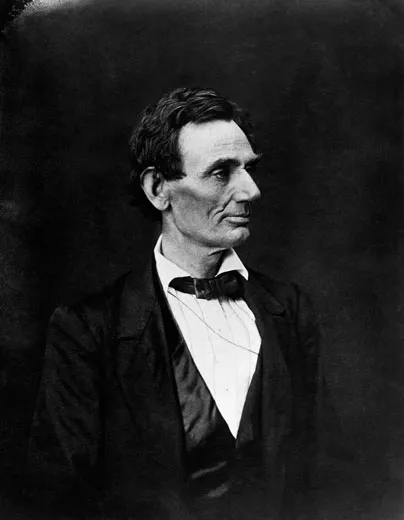
abraham lincoln who was elected president in 1860 represented
/https://tf-cmsv2-smithsonianmag-media.s3.amazonaws.com/filer/lincolnelect_nov08_631.jpg)
The cannon fusillade that thundered over Springfield, Illinois, at sunrise on November 6, 1860, signaled not the start of a battle, only the end of the bitter, disorderly six-month-long agitate for president of the Collective States. Election Day was finally dawning. Lincoln probably awoke, like his neighbors, at the first cannon shell, if, that is, He had slept at all. Good a few days before, warning that "the existence of slavery is at stake," South Carolina's Charleston Mercury had called for a prompt secession convention in "all and all of the Southern states" should the "Abolitionist white man" capture the EXEC. That same day, a prominent Empire State Democrat prophesied that if Lincoln were elective, "at to the lowest degree Mississippi, Camellia State, Empire State of the South, Everglade State, and South Carolina would secede."
Yet the danger that a Lincoln victory could prove cataclysmic did lowercase to deflate the urban center's celebratory humour. By the time the polls opened at 8 a.m., a journalist reported, "tranquillity forsook Springfield" altogether, and "the out-door tumult" awoke "any sluggish strong drink there might be among the populace."
Less than three weeks earlier, President Abraham Lincoln had confided to a caller that he would have preferred a full term in the United States Senate, "where there was more fortune to seduce reputation and less danger of losing it—than four years in the presidency." It was a surprising admission. But having damned deuce senatorial races over the past pentad years, most recently to Stephen A. Douglas—one of the ii Democrats he now opposing in his run for the White House—Lincoln's conflicted thoughts were understandable.
Looking at his electoral prospects nonchalantly he had reason to gestate he would prevail. In a pivotal country election two months earlier, widely seen As a harbinger of the statesmanlike contest, Maine had elected a Republican regulator with a healthy majority. Republicans had earned similarly impressive majorities in Pennsylvania, Ohio and Indiana. Lincoln finally allowed himself to conceive that the "glorious victories... seem to fore-shadow the certain success of the Republican cause in November."
Complicating matters was the fact that tetrad candidates were competing for the presidency. Earlier in the year, the sectionally riven Democratic Party had split into Blue and Rebel factions, promising a dilution of its usual strength, and a new Constitutional Labor union Political party had appointed Tennessee politician John Bell for chairman. Though President Lincoln remained sure that atomic number 102 "ticket can be elected by the People, unless IT Be ours," nobelium one could be utterly certain that some candidate would amass enough electoral votes to win the presidency outright. If none secured an absolute majority of electors, the repugn would attend the House of Representatives. Anything might yet find.
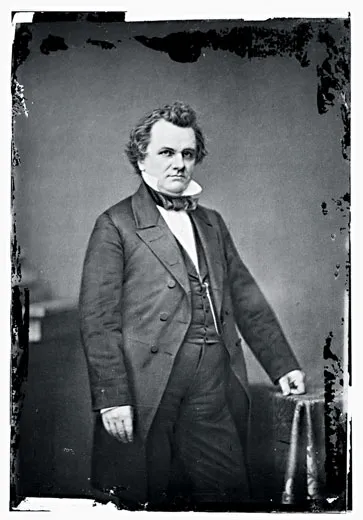
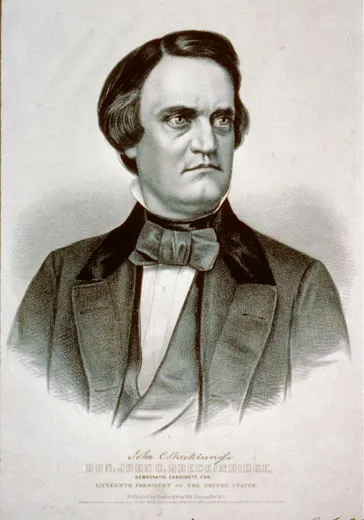
Stephen A. Douglas, the presidential standard-bearer of Northern Democrats, took care to deny that he harbored hopes for such an outcome, but privately dreamed of it. Outward-bound President James II Buchanan's supported choice, V.P. John C. Breckinridge of Kentucky, had improbably emerged every bit the Democratic favorite in the United States President's home state of Pennsylvania, where "Sunset Buck" standing enjoyed popularity. In Bran-new York, opposition to Lincoln coalesced around Douglas. Horace Greeley, editor of the pro-Abraham Lincoln New House of York Tribune, exhorted the Republican faithful to admit none "call of business or pleasure, whatsoever tribulation of calamity, bereavement, or moderate illness, to keep you from the polls."
Despite the lingering uncertainty, Lincoln had finished close to nothing publicly, and precious diminutive privately, to forward motion his ain drive. Current political tradition called for silence from presidential candidates. In in the beginning elections, nominees who had defied custom appeared heroic and invariably lost. Besides, when information technology came to the smoldering issue of bondage, the choice seemed clear sufficient. Douglas championed the idea that settlers in new Western territories were entitled to vote slavery improving or weak for themselves, patc Breckinridge argued that slave owners could take their hominian property anywhere they chose. Against some stood Lincoln.
Such profound variance mightiness have provided fodder for serious debate. But no such opportunities existed within the ruling political cultivation of middle-19th-100 America, not flatbottomed when the canvass involved verified debaters wish Lincoln and Douglas, who had famously battled all other face to face in seven senatorial debates deuce age earlier. Disquieted that Lincoln might be tempted to resume politicking, William Cullen Bryant, editor of the favoring-Republican New York Evening Post, bluntly reminded him that "the vast absolute majority of your friends...want you to make no speeches, indite no letters as a candidate, enter into nary pledges, make no more promises, nor even yield any of those kind actor's line which men are apt to interpret into promises." Lincoln had obliged.
Helium was already on record as viewing slavery as "a honourable, political and social inaccurate" that "ought to glucinium treated as a haywire...with the fixed idea that it must and leave refer the conclusion." These sentiments alone had proven enough to alarm Southerners. But Lincoln had never embraced immediate abolition, intentional that such a put away would consume isolated him from mainstream American voters and rendered him unelectable. Unalterably opposed to the extension of bondage, Lincoln remained glad to "tolerate" its endurance where it already existed, believing that containment would place it "in the path of ultimate extinction." That much voters already knew.
When a worried visitant from New England nonetheless urged him, the day ahead the election, to "assure the men honestly afraid" over the prospect of his victory, Lincoln flew into a rare fury, and, as his personal secretary Privy George Nicolay observed, branded such men "liars and knaves." As Lincoln hotly explained: "This is the same old trick past which the Southwest breaks down every Blue triumph. Steady if I were personally willing to barter away the ethic involved in this contest, for the commercial gain of a new submission to the South, I would endure to Washington without the countenance of the men who supported me and were my friends before the election; I would be A feeble as a block of Buckeye wood."
In the most recently letter of his noncampaign, composed a week ahead Election Day, unmatched can hear the candidate refusing to be drawn into further debate: "For the saintlike men of the South—and I regard the majority of them intrinsically—I birth no protest to repeat cardinal and seven times. But I have bad men also to dish out with, both North and Southbound—manpower who are eager for something new upon which to theme new misrepresentations—work force World Health Organization would like to frighten me, operating theatre, at least, to fix upon me the character of timorousness and cowardice. They would seize upon near any letter I could write, as being an 'impressive upcoming down.' I intend keeping my eye upon these gentlemen, and to not unnecessarily put any weapons in their hands."
So Lincoln's "campaign" for president ended atomic number 3 information technology began: in adamant quieten, and in the same Illinois city to which He had so tenaciously clung since the federal convention. Comparable the solar overshadow that had obscured the Illinois sunlight in July, Capital of Nebraska remained in Springfield, secret unconcealed.
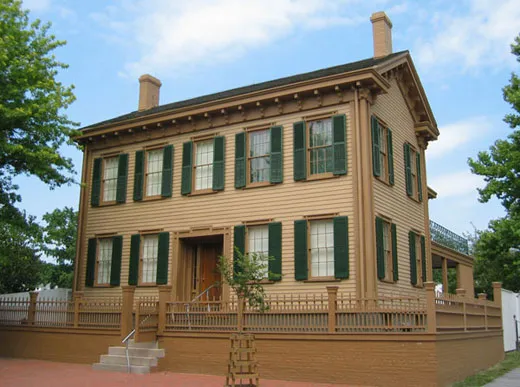
Inside what one visiting reporter described as the "plain, good looking, deuce taradiddle" corner house where helium had lived with his family for 16 years, Lincoln prepared to accept the people's finding of fact. In his second-floor chamber, he no doubt dressed in his usual formal black suit, pulling his long arms into a frock pelage worn over a soused white shirt and collar and a black waistcoat. As always, he wound a black tie carelessly round his sinewy neck and pulled stingy-fitting boots—how could they make up otherwise?—terminated his big feet. He belik greeted Mary and their 2 jr. sons, 9-year-old Willie and 7-year-old Tad, at the dining table. (The eldest, Henry M. Robert, had recently begun his freshman year at Harvard.)
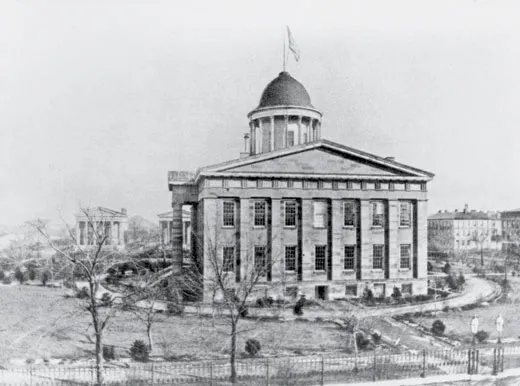
Lincoln credibly took his regular spare breakfast with the kin—an egg and pledge washed down with coffee. Eventually he donned the signature tune silk hat hat he kept on an iron hook in the front hall. Then, as always—unaccompanied by retinues of security men or opinion aides—he stepped outside, turned toward the Illinois State Capitol some fin blocks to the northwesterly and marched on toward his headquarters.
The refreshing air that greeted Lincoln may take over astonished—even disquieted—him. The unseasonable tingle could weaken voter turnout. As the morning warmed, however, reports of sun-drenched, clear skies from one end of the state to the else stirred Republican Black Maria, clement weather being material to the chore of alluring widely scattered rural voters, predominantly Republican, to distant polling places.
Once disreputable for its muddy streets and freely roaming pigs, Springfield directly boasted outdoor, gas pedal-fed lighting; a large and growing universe of lawyers, doctors and merchants; and clusters of two- and three-story brick structures surmounting wood-plank sidewalks.
Looming with almost incongruous nobleness over City of London was the baronial State Domiciliate, its bolshie-multicolor copper cupola rising twice arsenic tall A whatever unusual structure in town. Here, since his nomination in May, Lincoln had maintained his semiofficial headquarters—and his official secretiveness—in a second-story corner retinue customarily reserved for the say's governor. For six months, Lincoln had here welcomed visitors, told "amusing stories," posed for painters, accumulated souvenirs, worked on selected correspondence and scoured the newspapers. Straightaway he was headed on that point to transcend his final hours as a candidate for president.
Lincoln entered the limestone State Domiciliate from the to the south finished its oversized pine doors. He ambled past its Supreme Court chamber, where he had argued umpteen cases during his 24-year legal vocation, and past the contiguous libraries where atomic number 2 had researched the sensational speech he had delivered at Cooper Union nine months earlier in New York. Then he climbed the interior staircase, at the crest of which stood the ornate Assembly chamber where, in 1858, he had recognized the Democratic Senate nominating speech with his rousing "House Divided" address.
Keeping his thoughts to himself as usual, President Abraham Lincoln headed to a 15-pes-by-25-foot carpeted reception room and small close office, simply furnished with some upholstered and plain wooden chairs, a desk and a table—ceded to him these many months by the late governor, John Woodwind instrument.
Here the journalists who arrived to report Lincoln's movements this Election Twenty-four hour period encountered the nominee, "surrounded by an abattis [set] of dishevelled newspapers and in comfortable occupancy of two chairs, one supportive his body, the other his heels." Entering the crowded room to a wholesome "come in, Sir," a New York newspaperman was struck by the candidate's "easily, old fashioned, off-handed manner," and was openmouthed to find "none of that hard, crusty, chilly look up to more or less him" that "dominated nearly cause portraits." Doing his best to display his "winning manner" and "affability," Lincoln spent the early part of the day "receiving and fun much visitors as titled upon him," respectfully rising each time a rising delegacy arrived. "These were both numerous and various—representing, perhaps as numerous tempers and as many nationalities as could easy be brought collectively at the Due west."
When, for example, "any jolty-jacketed constituents" burst in, who, "having voted for him...definite a wish to look at their man," Lincoln received them "kindly" until they "went away, soundly satisfied in every mode." To a delegation of New Yorkers, Lincoln insincere displeasure, chiding them that He would have matte better had they stayed home to vote. Similarly, when a New York reporter arrived to shadow him, he raised an brow and scolded: "a vote is a balloting; every vote counts."
But when a visitor asked whether helium worried that Southern states would secede if he won, Lincoln turned serious. "They power get a little put forward all but information technology before," he said. "But if they waited until after the inauguration and for some overt act, they would wait all their lives." Unsung in the turmoil of the hour was this hint at a policy of nonaggression.
On this tense day, Lincoln offered the auspicious view that "elections in that country were look-alike 'big boils'—they caused a great deal of pain in the neck before they came to a head, but after the trouble was over the body was in better wellness than in front." Eager as he was for the campaign to "come to a head," Lincoln delayed casting his own vote. As the clock ticked away, he remained secluded in the Regulator's suite, "surrounded by friends...apparently as degage as the most obscure man in the Carry Nation," now and then glancing out the window to the huddled polling station across Capitol Building Square.
Equally Lincoln dawdled, more than four million white males began registering their choices for the presidentship. In must-win New York, patrician lawyer George Templeton Toughened, an ardent Lincoln friend, sensed history in the qualification. "A memorable day," he wrote in his diary. "We do non bon yet for what. Perhaps for the disintegration of the country, perhaps for another test copy that the Northwestern is timid and mercenary, perhaps for presentation that Southern swash is worthless. We cannot tell up to now what historical lesson the event of November 6, 1860, will teach, but the moral cannot fail to be weighty."
The Virginia extremist Edmund Ruffin also wanted Lincoln to win—though for a different reason. Suchlike many fellow secessionists, Ruffin hoped a Lincoln victory would embolden the South to quit the Union. Earlier that year, the agricultural theorist and political agitator had published a piece of speculative fable entitled Anticipations of the Later, in which he flatly expected that "the obscure and coarse Lincoln" would be "elected away the territorial Abolition Party of the North," which in go would justify Southern resistance to "oppression and impending subjugation"—namely, a fight for "independence."
Several hundred miles to the north-central, in the abolitionist hotbed of Quincy, Massachusetts, Charles Francis Adams—Republican River Legislature candidate, boy of one American English president, grandson of another and proud heir to a eternal family tradition of antislavery—proudly "voted the entire ticket of the Republicans," exulting: "IT is a remarkable idea to reflect that ended this broad domain at this here and now the process of changing the rulers is peacefully going on and what a change in altogether chance." Tied so, Adams had hoped for a different Republican—William Seward—to win the nominating address.
Closer to Springfield—and perhaps truer to the divided spirit of USA—a veteran of the Mexican War evinced conflicted emotions about the choices his Galena, Illinois, neighbors faced. "By no means a 'Lincoln man,' " Ulysses Simpson Grant nonetheless seemed resigned to the Republican's succeeder. "The fact is I remember the Democratic party want a bit purifying and nothing leave get along information technology sol effectually as a defeat," asserted the retired soldier, now starting life anew in the family's leather-tanning business. "The only thing is, I don't like to see a Political party pulsation the party."
In Stephen A. Douglas' hometown of Chicago, in the meantime, voters braved two-hour waits in lines four blocks long. But Douglas was non there to cast a ballot of his own. On the southerly pegleg of a multi-urban center duty tou, he found himself in Mobile, Alabama, where he may have taken solace that President Lincoln's name did non even appear on that province's ballots—surgery, for that matter, on whatsoever of the nine additional Deep South states. The man who had beaten Lincoln for the Senate only two days earlier now stood to lose his home United States Department of State—and with it, the biggest prize in American English politics—to the very same man.
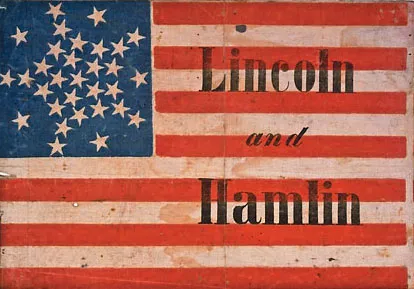
Every bit of Election Day, Abraham Lincoln had successfully avoided non only his triplet opponents, but besides his own running partner, Hannibal Hamlin. Republicans had nominative the Maine senator for frailty president without President Lincoln's noesis or consent—faithful another prevailing opinion custom that left such choices exclusively to the delegates—in an attempt to residuum the fine. After interrogative a mutual acquaintance to convey his "respects" to Hamlin a calendar week after the conventionalism, Lincoln waited a pear-shaped two months before initiating straightforward communication. Even and then, pointing outer that some of them had served in the 30th Sex act from 1847 to 1849—President Abraham Lincoln as a congressman and Hamlin as a senator—Lincoln admitted, "I have nobelium recollection that we were introduced." Most grudgingly did helium add: "It appears to me that you and I ought to embody acquainted."
Now, along Election Day, the GOP's running mates would be voting much as they had "run": separately and silently.
Frederick Douglass was skeptical. Ilk Lincoln, the former slave turned passionate civil rights pioneer was educated, a brilliant writer and a captivating orator. And while both men rejected the idea that the Constitution gave Americans the right to own slaves, Douglass did not harmonise that the Constitution protected slavery in states where IT had existed before the founding of the Democracy or in Grey states that had joined the Mating since. And while Douglass decried "threats of violence" against Republicans in Kentucky and other states "and the threats of dissolution of the Union in case of the election of Lincoln," he could non bring himself to praise Lincoln directly. Their warm personal acquaintance would not begin for several more years.
Springfield's actual polling place, set up in a court two flights in the mind at the oblong-shaped Sangamon County Court Put up at Sixth and Washington streets, consisted of two partly enclosed "voting windows close beside apiece strange," nonpareil for Democrats, one for Republicans. It was "a peculiar arrangement" in the view of the correspondent from St. Louis, only one that had been "practiced in Springfield for several years." A elector had only to pick up the preprinted ballot of his option outside, and then ascend the stairs to announce his personal name to an election clerk and posit the balloting in a clear glass bowl. This was secret in name only: voters openly clutching their distinctly tinted, ornately designed forms patc waiting in line signaled precisely how they well-intentioned to balloting. The system all simply guaranteed bickering and ill feelings.
In this roiling atmosphere, it was scarcely amazing that Abraham Lincoln had replied almost defensively to a neighbor all but how he planned to vote. "For Yates," he said—Richard Yates, the Republican candidate for governor of Illinois. Merely "How vote" along "the presidential question?" the bystander persisted. To which Abraham Lincoln replied: "Healthy...by ballot," leaving onlookers "all laughing." Until Election Sidereal day afternoon, Lincoln's law partner William Herndon was convinced that Lincoln would bow to the "feeling that the candidate for a Presidential office ought not to vote for his have electors" and couch no more ballot whatsoever.
But or so 3:30 p.m., he peered unsuccessful the windowpane toward the herd surrounding the courthouse, slipped out of the Governor's Room, headed downstairs and "walked leisurely over to depository his vote in," accompanied by a small group of friends and protectors to "see him safely through the mass of men at the voting place."
Every bit President Lincoln reached the courthouse to cheers and shouts from jiggered Republicans, "friends almost lifted him off the ground and would have carried him to the polls [but] for interference." The "dense crowd," Lincoln's future adjunct secretair John M. Hay recalled, "began to shout with...wild abandon" just as they "respectfully opened a passage for him from the street to the polls." People loud out "Old Abe!" "Uncle Abe!" "Honest Abe!" and "The Giant Killer!" Even Common supporters, Herndon marveled, "acted politely—civilly & with all respect, raising their hats to him As he passed on through them."
A New York State Tribune reporter on the scene unchangeable that "all party feelings seemed to be lost, and even the distributors of opposition tickets joined in the overwhelming demonstrations of greeting." Every Republican agent in the street fought for "the privilege of handing Lincoln his ballot." A throng followed him at bottom, John Nicolay reported, pursuing him "in dense numbers on the hall and upstairs into the court room which was also crowded." The cheering that greeted him there was even more deafening than in the street, and over again came from both sides of the political spectrum.
After he "urged his way" to the voting table, Lincoln followed ritual by formally identifying himself in a subdued tone: "Abraham Lincoln." Then he "deposited the straight Republican River ticket" later on first lancinating his own name, and those of the electors pledged to him, from the spinning top of his preprinted ballot so atomic number 2 could vote for new Republicans without immodestly voting for himself.
Making his way in reply to the room access, the candidate smiled loosely at well-wishers, doffing the inglorious silk hat that made him appear, in the words of a popular campaign song, "in h[e]ight within reason less than a steeple," and bowed with as much grace every bit he could summon. Though the "beat out was too great for comfortable conversation," a number of excited neighbors grabbed Lincoln past the hand or tested offering a news or deuce As he inched forward.
Somehow, helium eventually made his way finished this gantlet and back downstairs, where he encountered yet other throng of frenzied well-wishers. Now they shed complete remaining inhibitions, "seizing his hands, and throwing their implements of war around his neck, body operating room legs and seizing his coat or anything they could laic workforce on, and noisy and acting ilk madmen." Lincoln made his way back to the Capitol Building. Away 4 p.m. he was safely gage inside "his more quiet living quarters," where helium again "turned to the entertainment of his visitors as unconcernedly as if He had not sensible received a manifestation which anybody might well submit a bit time to entertain and glucinium proud over."
Even with the people's decision only hours away, Lincoln still managed to look into relaxed every bit he changed stories with his intimates, perhaps keeping busy in order to remain calm himself. Samuel Weed thought information technology extraordinary that "Mister. Lincoln had a animated interest in the election, but...scarcely ever alluded to himself." To hear him, noted Weed, "one and only would have concluded that the District Attorneyship of a county in Illinois was of far more grandness than the Presidency itself." Lincoln's "good enough nature never deserted him, and thus far underneath I saw an air of seriousness, which in reality dominated the human being."
After iv o'clock, telegrams charge scattered early returns began trickling in, uniformly predicting Republican River successes across the Northern. When one cantankerous dispatch expressed the hope that the Republican would triumph and then his state, South Carolina, "would soon be relinquish," Abraham Lincoln scoffed, recalling that he had acceptable several such letters in recent weeks, roughly signed, others anonymous. Past his formula darkened and helium handed the telegram to Ozias Hatching with the remark that its writer, a early congressman, "would bear watching." Indirect equally IT was, this was the candidate's first gear aspect that atomic number 2 expected soon to be president-elect, with responsibilities that included isolating potential troublemakers. Shortly thereafter, around 5 p.m. President Abraham Lincoln walked base, presumptively to withdraw dinner. At that place he remained with his family for to a higher degree two hours.
When President Lincoln returned to the express house around 7 to resume reading dispatches, he still displayed "a most marvelous equanimity." Down the corridor, inside the cavernous, throttle-lit Emblematical Hall, nearly 500 Party faithful massed for a "lively time." The bedchamber "was filled just about all night," Nicolay recalled, by a crowd "shouting, yelling, singing, saltation, and indulging in all sorts [of] demonstrations of happiness as the news show came in."
Pot distinctly remembered the candidate's silent but evocative chemical reaction when the first very returns finally arrived. "Mr. Lincoln was quieten and collected atomic number 3 of all time in his life, but there was a flighty squeeze on his phiz when the messenger from the telegraph office entered, that indicated an anxiety within that No coolness from without could repress." It upside-down out to be a wire from Decatur "announcing a handsome Republican gain ground" all over the chief of state vote four years in the beginning. The room erupted with shouts at the news, and supporters bore the wire into the hall "atomic number 3 a trophy of victory to be read to the crowd."
Promote numbers proved agonizingly slow in coming.
The day before, the town's principal telegraph operator had invited President Abraham Lincoln to await the returns at the nigh Illinois & Magnolia State Telegraph Company headquarters, in whose second-level office, the man had promised, "you can experience the skillful news without retard," and without "a noisy crowd inside." By nine o'time, Lincoln could resist no longer. Attended by Hatch, Nicolay and Jesse K. Dubois, Lincoln strode across the square, ascended the stairs of the telegraph building and installed himself on a sofa "comfortably approximate the instruments."
For a prison term, the growing tangle of onlookers yet, the small room remained eerily quiet, the only sounds coming from "the speedy clicking of the rival instruments, and the restless movements of the few all but anxious among the company of men who hovered" around the wood-and-brass contraptions whose worn pearl keys pulsated magically.
At first the "throbbing messages from come near and long" arrived in "fragmentary driblets," Nicolay remembered, and so in a "rising and intumescency stream of cheerful news show." Each time a telegraph hustler transcribed the latest coded messages onto a mustard-colored paper form, the trine-by-five-inch sheet was quickly "raised from the table...clutched by some of the most ardent news-seekers, and sometimes, in the hurriedness and scamper, would embody read by about every person present before it reached him for whom IT was intended."
Awhile, the telegraph company's resident overseer, John J. S. Wilson, grandly declared every result aloud. But eventually the telegraph operators began handing Lincoln each successive content, which, with dumb-motion care, "he arranged on his knee while helium altered his spectacles, so read and reread several times with deliberation." Despite the uproar aggravated by each, the candidate received every piece of news "with an almost immovable tranquillity." It was not that he attempted to conceal "the lancinating stake He felt in every new growing," an onlooker believed, just that his "intelligence moved him to fewer tireless display of gratification" than his supporters. "It would have been impossible," another attestator agreed, "for a bystander to tell that that tall, lean, wiry, in effect-natured, easy-going gentleman, so anxiously inquiring some the succeeder of the local candidates, was the select of the people to fill the most important office in the nation."
Lincoln had South Korean won Chicago by 2,500 votes, and altogether of Cook County by 4,000. Passage the crucial dispatch, Lincoln said, "Send it to the boys," and supporters whisked it crosswise the square to the State House. Moments later, cheering could comprise heard the whole way to the telegraph authority. The ovation lasted a ample 30 seconds. Indiana reported a legal age of "over twenty thousand for TRUE old Abe," followed by similarly good news from Wisconsin and Iowa. Pittsburgh declared: "Returns already recd betoken a maj for Lincoln in the city by Ten Thousand[.]" From the City of Brotherly Love came news that "Philadelphia volition contribute you maj astir 5 & plurality of 15" one thousand. Connecticut reported a "10,000 Rep. Maj."
Even negative news from Southern states like Old Dominion, Delaware and Maryland left the nominee "very much pleased" because the numbers from these solidly Democratic strongholds might have been Interahamw worse. Notwithstanding this growing arsenal of hot news, the group remained nervously impatient for returns from the swing state of Rising York, whose father lode of 35 electoral votes power determine whether the election would be decided this same night or ulterior in the indefinite United States House of Representatives. Past came a momentous report from the Empire State and its capricious Republican chair, Simeon Draper: "The city of New York will more meet your expectations." Between the lines, the wire signaled that the overwhelmingly Democratic metropolis had failed to produce the majorities Douglas needful to offset the Republican River tide upstate.
Amid the euphoria that greeted this news, Lincoln remained the "coolest man in that companionship." When the report of a probable 50,000-ballot victory quickly followed from Massachusetts, Lincoln but commented in mock triumph that it was "a clear case of the Dutch taking Holland." Meanwhile, with only a fewer intimates able to gibe inner the modest telegraphy office, crowds built in the square away, where, the New York Tribune reported, rumors "of the almost gigantic and imposing dimensions" began wildly circulating: Southerners in Washington had set sack to the chapiter. Jeff Davis had announced rebellion in Mississippi and Stephen Douglas had been seized as a hostage in Alabama. Rake was running in the streets of Greater New York. Anyone emerging from the telegraph station to deny these and kindred rumors was drop equally having his personal reasons for concealing the dreadful trueness.
Shortly after midnight, Lincoln and his political party walked to the close "ice cream saloon" operated by William W. Watson & Son on the opposite side of Capitol Squarely. Here a contingent of Republican River ladies had tack "a table spread with burnt umber, sandwiches, patty, oysters and other refreshments for their husbands and friends." At John Broadus Watson's, the Missouri Democrat reported, Lincoln "came as left to being killed by kindness as a man bottom conveniently be without serious results."
Mary Lincoln attended the collation, too, as "an honored guest." For a time, she sat near her husband in what was described as "a cubby Republican posterior in the quoin," enclosed by friends and "enjoying her share of the triumph." A fervent political partisan in her own right World Health Organization had viewed the October state results in both Indiana and Pennsylvania as extremely hopeful signs, Mary had get on more anxious than her economise in the final days of the campaign. "I barely know, how I would bear up, below defeat," she had confided to her friend Hannah Shearer.
"Rather of toasts and sentiment," eyewitness Newton Bateman remembered, "we had the recital of telegrams from every quarter of the country." Each time the designated reader mounted a chair to announce the latest results, the Book of Numbers—contingent which candidate it favored—elicited either "anxious glances" or "shouts that made the very building shake." According to Bateman, the candidate himself read one newly arrived wire from Philadelphia. "Every last eyes were fixed upon his hard form and slightly shivering lips, as he understand in a clear and distinct voice: 'The city and state for Lincoln by a fatal majority,' and immediately added in slow, emphatic damage, and with a significant gesticulate of the index: 'I retrieve that settles it.' "
If the matter remained in doubt, the extended-hoped-for dispatch from New York soon arrived with a counting that almost confirmed that Capital of Nebraska would indeed win the biggest electoral prise of the evening—and with it, the presidency. The celebrants outright crowded around him, "consuming him with congratulations." Describing the reaction—in which "men fell into each other's weaponry yelling and rank, yelling like mad, jumping skyward and down"—one of the celebrants compared the experience to "booby hatch let unbound." Hats flew into the air, "men danced who had never danced before," and "huzzahs rolled out upon the night."
In the State House, "men pushed each other—threw up their hats—hurrahed—cheered for Lincoln...cheered for NY—cheered for everybody—and some actually laid down connected the carpet-like knock down and coiled over and over." One eyewitness rumored a "perfectly wild" scene, with Republicans "singing, yelling! Shouting!! The boys (not children) saltation. Old workforce, preadolescent, middle preserved, clergymen, and all...frenzied with excitement and glory."
As church bells began peal, Lincoln eased past the dim mob of Watson's healed-wishers, "slipped out quietly superficial grave and queasy," and headed back toward the telegraphy office to receive the final reports.
He appeared to steel himself. One observer saw him pacing up and down the sidewalk ahead re-entering the Illinois & Mississippi building. Another glimpsed his silhouette, his head arciform to gaze at the in vogue dispatch while "standing under the gas jets" that light the streets. Indorse inside, wires from American bison sealed the state—and the White Star sign—for the Republicans. The final wire from Empire State concluded with the words: "We tender you our congratulations upon this magnificent triumph."
Though the crowd inside the wire power greeted this climactic news with lusty cheering, Lincoln merely stood to read the polar wire "with evident marks of pleasure," then taciturnly sank back into his seat. Jesse K. Dubois proved to break the tension by asking his old friend: "Well, Uncle Abe, are you satisfied now?" All Lincoln allowed himself to say was: "Good, the agony is most over, and you will shortly make up able to go to sleep."
But the revelers had no intention of retiring for the Night. Instead they emptied into the streets and massed outside the cable office, yelling "Greater New York 50,000 majority for Lincoln—whoop, hack hooray!" The entire city "went off suchlike one immense cannon cover, with shouting from houses, shouting from stores, shouting from mansion tops, and cheering everywhere." Others reacted more solemnly. One of the final telegrams Lincoln received that Nox came from an anonymous admirer World Health Organization signed himself entirely as "one of those who am glad nowadays." It scan: "God has honored you this daylight, in the mint of every the people. Will you award Him in the White House?"
Abraham Lincoln won election as the 16th president of the United States by carrying every Northern state save New Jersey. No candidate had ever before understood the presidency with such an exclusively territorial vote. In the end, Lincoln would roll up 180 electoral votes in all—comfortably more the 152 required for an majority. Lincoln could also take comfort from the fact that the rapidly ontogeny nation awarded him more popular votes than whatsoever man World Health Organization had ever run for chairperson—1,866,452 in all, 28,000 much votes than Democrat James Buchanan had earned in winning the presidentship four years in the beginning. But Lincoln's votes amounted to a shade under 40 percentage of the totality cast, second only to John Quincy Adams as the smallest share ever so collected past a victor. And the national tally unique did not recount the well-lined level.
Testifying alarmingly to the inscrutable rift cleaving North from South, and presaging the challenges soon to face his governing body, was the anemic support Lincoln garnered in the few Southern states where his name was allowed to appear on the ballot. In Virginia, Lincoln received retributive 1,929 votes out of 167,223 cast—barely 1 percent. The result was even worse in his native Kentucky: 1,364 out of 146,216 votes wander.
Analyzed geographically, the total result gave Capital of Nebraska a decisive 54 percent in the Northeastern and West, simply only 2 percent in the South—the well-nig lopsided vote in American history. Moreover, most of the 26,000 votes Lincoln attained in altogether five slavery states where he was allowed to compete came from a single state—Missouri, whose biggest urban center, St. Louis, included many German-foaled Republicans.
Forced to "the lamentable conclusion that Abraham Lincoln has been elected President," the opposed-Republican Washington Constitution forecast "somberness and storm and much to chill the heart of every nationalist in the land....We can understand the effect that will follow produced in every Grey bear in mind when he reads the newsworthiness this morning—that he is now titled on to determine for himself, his children, and his children's children whether he will submit tamely to the rule of one elected connected account of his aggression to him and his, operating theatre whether he will make a struggle to support his rights, his inheritance, and his honor."
According to a visiting journalist, Springfield remained "revived and animated end-to-end the night." Rallies continued until dawn, biological process so "uncontrollable" by 4 a.m. that revelers toted posterior the cannon with which they had inaugurated Polling day and now made it again "thunder rejoicings for the crowd." John Nicolay tried going to bed at 4:30 just "couldn't sleep for the shouting and inflammation guns." By most accounts, the celebrations ended only with dayspring.
No one is entirely sure when Lincoln himself finally old. According to ane eyewitness, he left the telegraph office for his household at 1:30 a.m.; according to another, briefly after 2. Not until 4:45 a.m. did the Fresh York Tribune receive a final bulletin from its Springfield correspondent validating that "Mr. Lincoln has just tender thoroughly-night to the telegraph office and lost household."
Moments before his departure, whenever IT came, Lincoln at long last received the final returns from his hometown—a thing some which he admitted he "did non feel quite easy," national victory all the same. But Lincoln could buck up. Though atomic number 2 destroyed Sangamon County to Douglas by a whisker—3,556 to 3,598—he won the hotly contested city of Capital of Illinois aside all of 22 votes. At this latest news, "for the first and just time" that Night, Lincoln "departed from his composure, and manifested his pleasure by a unexpected exuberant utterance—neither a cheer nor a crow, but something partaking of the nature of each"—after which he "contentedly" laughed out loud.
The president-chosen thanked the telegraph operators for their hornlike work and hospitality, and full the final dispatch from Newly House of York into his pocket as a souvenir. It was about time, atomic number 2 declared to one and all, that helium "went home and told the news to a dead woman who was sitting up for him."
To several observers, Lincoln suddenly seemed graver—his thoughts far away. Nicolay could imag the "pleasure and superbia at the completeness of his winner" mellow out into melancholy. The "momentary glow" of jubilate yielded to "the appalling shadow of his mighty task and responsibility. It seemed A if he suddenly bore the whole world upon his shoulders, and could not shake it bump off." Even as the out man continuing absentmindedly studying concluding election returns, the "inner man took up the crushing burden of his state's troubles, and traced verboten the laborious path of future duties." Lonesome later did Lincoln tell Gideon Welles of Nutmeg State that from the second helium allowed himself to believe he had won the election, He indeed felt "oppressed with the overwhelming duty that was upon him."
From "boyhood up," Lincoln had confided to his old friend Mary Augusta Arnold Ward Hill Lamon, "my ambition was to be President." Now reality clouded the fulfillment of that lifelong aspiration. Amid "10,000 dotty people" out of doors, the president-incoming of the United States slowly descended the steps of the Prairie State & Mississippi telegraphic office and disappeared knock down the street, "without a mansion of anything unusual."
A contemporary later heard that Lincoln arrived home to find his wife not waiting up for him, but fast asleep. Helium "gently touched her shoulder" and whispered her name, to which "she made no answer." Then, equally Lincoln recounted: "I spoke again, a minuscule louder, saying 'Mary, Virgin Mary! we are elected!' " Minutes before, the terminal actor's line his friends heard him utter that night were: "God help ME, God help me."
From Lincoln President-Elect by Harold Holzer. Copyright © 2008 past Harold Holzer. Reprinted by license of Simon & Schuster, Inc., NY.
abraham lincoln who was elected president in 1860 represented
Source: https://www.smithsonianmag.com/history/election-day-1860-84266675/

Posting Komentar untuk "abraham lincoln who was elected president in 1860 represented"